Is Precast Stone Veneer
the New Synthetic Stucco Water Damage Nightmare? By Paul King-Licensed General Contractor & Licensed Home Inspector Precast or manufactured stone veneer has become extremely popular in recent years.
After all it’s a beautiful product, it makes the home look grand and structurally sound (in my opinion), and
is a nice alternative to brick, cement fiber, vinyl, stucco or wood. Many builders like at as well because it is less expensive than brick, but many are
able to charge buyers the same price or more than brick veneer so they can increase their profit margins. Personally, I like the product so much that the next home I build
for my family will be partially clad with precast stone veneer.Since moving back to the Carolinas several years ago I have inspected thousands of homes, hundreds
clad with precast stone and the popularity of the product is increasing. Unfortunately, the vast
majority of the installations of precast stone veneer and its related components we’ve inspected do not come close to
meeting requirements as they are written. Despite overwhelming evidence some builders and precast stone
subcontractors are trying to convince buyers there are no issues and pushing new home buyers to believe the installations
are fine. Unfortunately, from what we’ve seen many buyers end up believing that the precast stone
was correctly installed and do not demand the builder to sure the issue. Knowledgeable private inspectors
are often accused of being incorrect, after all when someone says something along the line of “...that’s the way
we always do it...” or “...it passed code so it must be correct…” many reasonable people will buy
the statement. Sadly the trusting buyers that believe that statement are likely to wind up with severe
water damage, compromised structural components, and possible mold growth inside walls that will require replacement of the
precast stone veneer, framing, insulation, sheetrock, etc in a matter of a few years. Also, by the time
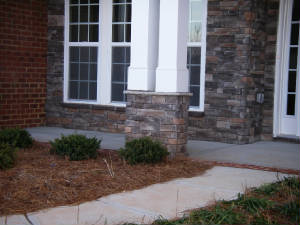
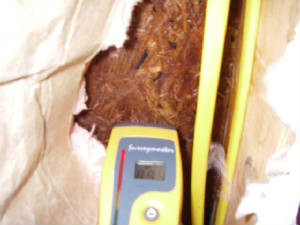
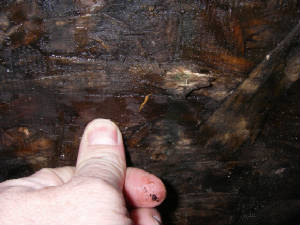
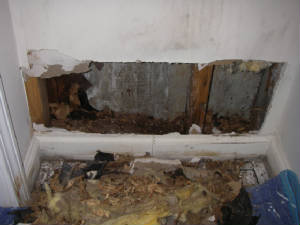
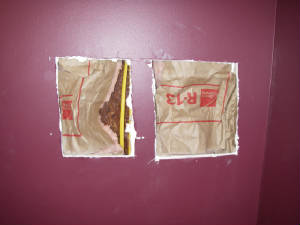
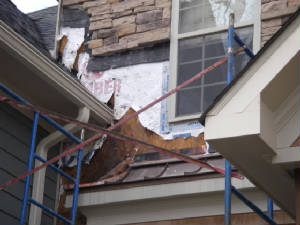
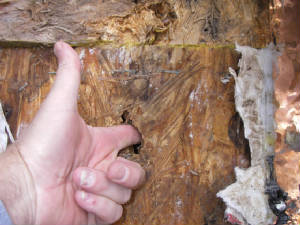
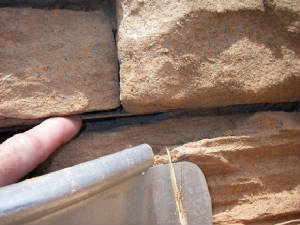
they uncover the problem the structural damages are likely to be severe. I took the photos above from
outside and inside a beautiful custom built home less than two year's old home where the exterior wall
was clad with precast stone veneer. The installation is typical of what we see locally, the exterior walls
looked beautiful and showed no visible evidence of problems. The interior walls showed no indications of
problems, only a small stain became evident in a corner of the baseboard. When the sheetrock was cut away
from the interior walls and the insulation was moved over the entire wall sheathing was saturated with water; an inspection
of the bandsill and foundation plate in the crawlspace indicated water damages as well. Most homeowners,
contractors, and inspectors do not see the problem until the sheetrock walls show evidence of moisture and by the time the
moisture gets that far the structural damage is typically extensive. In the case of this home the repairs were
several thousands of dollars. Some
people say the problem is that there are minimal building codes that builders must adhere to, but actually there are plenty,
many of which have been in existence for quite some time. Failure to following these codes as well as the
stone manufacturer’s installation and or flashing instructions are typically the root causes that lead to that vast
majority of all of the problems. For starters people need to realize that building codes “establish
minimum regulations”, meaning codes are absolute minimums that must be met. Both North Carolina and
South Carolina have currently adopted 2003 International Residential Code and 2003 International Building Code; North Carolina
code has some minor revisions to International Code. 2006 IRC and IBC have been published for years so
one could easily come to the conclusion that any revisions in 2006 codes should be known by builders and specialty contractors
and that a standard of care and good construction practices would entice contractors to adhere to the 2006 code revisions
despite their yet being adopted. Unless otherwise noted any codes will be 2006 NC Residential Code/2003 IRC and/or 2006 NC Building
Code/2003 IBC.The International Code Council has published
“ICC-AC51-ACCEPTANCE CRITERIA FOR PRECAST STONE VENEER” for several years in an attempt to clarify
what codes should be followed.In ICC-AC51 you have the following:· “Section 1.2 …The veneer system is considered a variation of exterior plaster regulated by IBC Section 2512, IRC
Section 703.6,…and a variation of adhered masonry veneer regulated by IBC section 1405.9…”·
“Section 2.1.1 Installation
Instructions.”· “Section 2.1.2.1 Installation under the IBC & IRC: The installation instructions must comply with IBC Sections 1403.2
and 2512.1…” “Except when installation is over concrete or masonry walls, a water-restrictive
barrier is required under the precast stone veneer system. The water-restrictive barrier shall comply with
IBC Sections 1404.2 and 2510.6 or with IRC Sections R703.2 and R703.6.3, as applicable.”·
“Section 6.0 Evaluation
Report Recognition”· “6.3 Requirements for water-restrictive barrier, flashing, and weep screeds. For installations under the
IBC and IRC, weep screeds shall have weep holes at least 3/16 inch (4.8 mm) in diameter, spaced less than 33 inches on center,
in accordance with Section 6.1.5.2 of ACI 530.” What do the NC & ICC Codes say? “R102.4 Referenced codes and Standards. The codes and standards referenced in this code shall be considered part of the requirements of this to
the prescribed extent of each such reference. Where differences occur between provisions of this code and
referenced codes and standards, the provisions of this code shall apply. Exception: Where
enforcement of a code provision would violate the conditions of the listing of the equipment or appliance the conditions of
the listing and manufacturer’s instructions shall apply.” Most construction professionals
believe this to say, if there is a manufacturers installation instructions they must be followed. Unfortunately
many of the precast stone manufacturers do not have ICC acceptance and have not printed installation instructions.
According to one industry source less than 5% of all precast stone manufacturers have ICC acceptance for their products.“R703.6 Exterior plaster.” “R703.6.1 Lath.” Lath should not be visible in a non-destructive/typical inspection of a completed home.
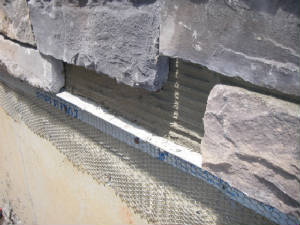
If any lath is visible the veneer is not properly installed.“R703.6.2.1 & IBC 2512.1.2 Weep Screeds. A minimum 0.019-inch (0.48mm)( No. 26 galvanized sheet gauge), corrosion-resistant
weep screed or plastic weep screed, with a minimum vertical attachment flange of 3 ½ inches (89mm) shall be provided
at or below the foundation plate line on exterior stud walls in accordance with ASTM C 926. The weep screed
shall be placed a minimum of 4 inches (102mm) above the earth or 2 inches (51mm) above paved areas and shall be of a type
that will allow trapped water to drain to the exterior of the building. The weather-resistant barrier shall
lap the attachment flange. The exterior lath shall cover and terminate on the attachment flange of the
weep screed.” The vast majority of the precast stone veneer installations we have inspected
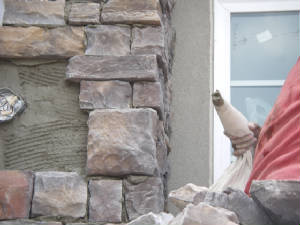
have no weep screed installed and the stone is installed to the ground and paving, a clearly visible omission of code requirements. “R703.6.2 Plaster & 2512.1.1 On-grade floor slab. “…On wood frame construction with
an on-grade floor slab system, exterior plaster shall be applied in such a manner as to cover, but not extend below, lath,
paper, and screed.” The lath and paper should not be visible during inspection of a completed
home, but if the weep screed is omitted as typically found, this code provision cannot be met.2006 IRC although not yet adopted locally, adds a new requirement.
“R703.6.3 Water-Restrictive Barriers. Water-restrictive barriers shall be installed
as required in section R703.2 and, where applied over wood-based sheathing, shall include a water-restrictive vapor barrier
with a performance at least equivalent to two layers of Grade D paper. Exception. Where
the water restrictive barrier that is applied over wood-base sheathing has a water resistance equal to or greater than that
of 60 minute Grade D paper and is separated from the stucco by an intervening, substantially, non-water absorbing layer or
designed drainage space.” The publication “Significant Changes to the IRC 2006 Edition”
by Hamid Naderi, P.E. & Douglas W. Thornburg, AIA states “Experience has shown that the typical method of protection
for exterior wood sheathing has created problems for some types of exterior plaster. Grade D paper appears
to have the proper permeability characteristics to prevent entrapment of moisture, thereby eliminating most of such moisture-related
problems behind plaster applications.” The few manufactured stone companies that publish installation
instructions require two overlapped layers of Grade D paper. Unfortunately this cannot be inspected
unless an under construction inspection is performed during a very short window and most builders are not likely to stop construction
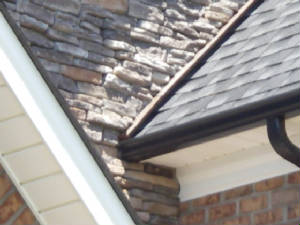
so you can schedule a private inspection of this step. “R703.8 Flashing. Approved corrosion-resistant flashing shall be provided in the exterior wall envelope in such a manner as
to prevent entry of water into the wall cavity or penetration of water to the building structural framing components.
The flashing shall extend to the surface of the exterior wall finish and shall be installed to prevent water from reentering
the exterior wall envelope. Approved corrosion-resistant flashings shall be installed at all of the following
locations:1. At top of all exterior window and door openings in such a manner as to be leakproof, except that self-flashing
windows having a continuous lap of not less than 1 1/8 inches (28 mm) over the sheathing material around the perimeter of
the opening, including corners, do not require additional flashing; jamb flashing may also be omitted when specifically approved
by the building official. 2. At the intersection of chimneys or other masonry construction with frame or stucco
walls, with projecting lips on both sides under stucco copings.3. Under and at the ends of masonry, wood or metal copings and sills.4. Continuously
above all projecting wood trim.5. Where exterior porches, decks, or stairs attach to a wall or floor assembly of wood
frame construction.6. At wall and roof intersections.7. At built-in gutters.”2006 North Carolina R703.8 adds “Install flashing per ASTM E 2112 Standard
Practice for Installation of Exterior Windows, Doors, and Skylights, or in accordance with the manufacturer’s supplied
written instructions. Aluminum flashing may not be used in contact with cementitious material except at
counter flashing.” Many of these code provisions are typically not met.“1403.2 Weather Protection. Exterior walls shall provide the building with a weather-resistant
exterior wall envelope. The exterior wall envelope shall include flashing, as described in section 1405.3.
The exterior wall envelope shall be designed and constructed in such a manner as to prevent the accumulation of water
within the wall assembly by providing a water-restrictive barrier behind the exterior veneer, as described in section 1404.2
and a means for draining water that enters the assembly to the exterior of the veneer, unless it is determined that penetration
of water behind the veneer shall not be detrimental to the building performance….” This cannot be
fully evaluated in a completed home. “1404.2 Water-resistive barrier. A minimum of one layer of No. 15 asphalt felt, complying with ASTM D 226 for Type 1 felt, shall be attached to the
sheathing, with flashing as described in Section 1405.3, in such a manner as to provide a continuous water-restrictive barrier
behind the exterior wall veneer.” This cannot be inspected in a completed home.“2510.6 Weather-resistant barriers. Weather resistant barriers shall be installed as required in section
1404.2 and, where applied over wood based sheathing, shall include a weather-resistant vapor-permeable barrier with a performance
at least equivalent to two layers of Grade D paper.” This cannot be inspected in a completed home.While some items cannot be inspected in a
completed home without being destructive many of the code provisions can be inspected. If the installer/contractor,
who one would consider to be a professional in that specific trade, was unaware of the code provisions and often times the
manufacturers installation instructions or just simply ignored them with regards to what can be visibly inspected in completed
construction how confident can we be that they followed all of the code provisions and manufacturers installations instructions
for the components that cannot be inspected without being destructive?If they disagree with what has been made obvious it should raise concern that there
are hidden issues as well.Why,
may you ask, would a precast stone sub contractor try to convince a buyer or homeowner that their installation was correct?
The cure would involve tearing off the much and possibly even all of the veneer. That may expose
water damage and deterioration. Everything removed would have to be thrown away and a new installation
would have to be performed. Neighbors with precast stone would see the repair and/or hear of the repair
and want their home corrected as well. If the precast stone contractor has failed to install the veneer
on thousands of homes what is the possibility of them being able to afford return to all of those homes and correct their
mistakes without going bankrupt? Two of the higher quality, larger precast
stone manufacturers are Owens Corning Cultured Stone and Centurion Stone; they are also two of the most commonly installed
brands locally. Listed below are links to their ICC evaluation reports and installation and or flashing
instructions.
In 2010 The
North Carolina Department of Insurance, Department of Engineering and Codes, published a clarification of installation requirments
and recommendations for Adhered Masonry Veneer. Some important points for readers to note include this was not a change
in the states building code requirements (rather a clarification because of common installation issues that have lead to water
damage). The full clarification can be read at the link below.
NC Department of Engineering and Codes clarifiaction of installation requirements for Adhered Masonry Veneer
NC Home Inspectors Licensure Board Recommended Language for Improper Artificial Stone Installation
Masonry Veneer Manufacturers Association Installation Guide
Owens Corning Cultured Stone ICC Report
Owens Corning Cultured Stone Installation Instructions
Owens Corning Best Practices for Flashing Detail
Centurion Stone ICC Report
Centurion Installation & Flashing Manual
Centurion Stone Flashing Intructions
Centurion Stone Installation Instructions
ICC-AC51-ACCEPTANCE CRITERIA FOR PRECAST STONE VENEER
Below
are links to several published stories by other contractors and engineers detailing the water intrusion and damage problems
they have encountered when a contractor fails to install and flash precast stone properly.
Manufactured-Stone Nightmares-by Dennis McCoy-Dec. 2004 Journal of Light Construction
The Perfect Storm Over Stucco-by-Joseph W Lstiburek-ph.d. p.eng.-Feb 2008 ASHRAE Journal
Rescuing A Manufactured-Stone Wall by Mark Parlee-Dec-2008-Journal of Light Construction
NC Home Inspector Licensure Board recommended language for manufactured stone veneer
Click here for SC Residential Code Information
Area homes could be at risk for water damage
Posted:
Feb 18, 2009 02:30 PM EST
Updated:
March 18, 2009 12:01 AM EDT
By Jamie Boll - bio l email
Produced by Jeffrey Keene - email
CHARLOTTE, NC (WBTV) - Brian Jones would seem to be an unlikely victim of a water damaged home.
He's a homebuilder in the Charlotte area and after years of building other people's dreams he decided to build his own.
About a year after moving into his York County home he noticed water damage in his dining room.
"I do this for a living for other folks and all of the sudden you get an issue like this that you don't expect," said Jones.
Jones is now stuck with a $3,000 dollar repair bill.
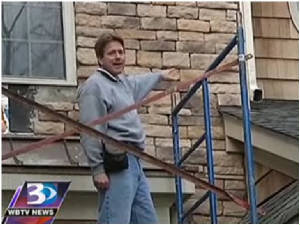
Certified Home Inspector Paul King says the problem was with the installation of a popular home exterior product.
"I can honestly say that 95% of the time it's not installed properly," said King.
Click the red camera to watch this Problem Solver Investigation.
PSI:
Water seeps through home exteriors
Posted: July 8, 2009 12:17 PM EDT Updated: July 8, 2009 11:33 PM EDT |  |  | | | |
By Jamie Boll - bio l email Produced by Jeff Keene - email Charlotte, NC (WBTV) - Laura Streeter knew she had a problem with her Southwest
Charlotte home. Where it was coming from and how big were the two questions she couldn't get answered. "It
was about 2003," said Streeter. "I noticed some moisture coming in and the smell of mildew in the closet inside
my house." She called out various handymen, contractors and roofers trying to put a stop to the water seeping
into her home. The damage had cost her a new door, window and flooring. It's when she saw a Problem Solver Investigation
we aired back in March. "It just made me realize, oh, this is probably what's causing the water to get into
my home," said Streeter. It turns out the cause was the same. The precast stone veneer exterior on
her home was not installed correctly. "It's a wonderful product it it's properly installed," said Certified
Home Inspector Paul King. It wasn't installed correctly on Streeter's home. Metal pieces called weep screeds,
which allow water to funnel away, were missing. The seams in the gaps of the stones weren't filled with the grout.
Streeter isn't alone. Karen Jones lives just one street over in the Harbor Club subdivision near Lake Wyllie.
She's has the same water intrusion issues. Jones says she knows of four other people in the neighborhood having the
same problems. "It should have been caught right away," said Jones. "Now, as homeowners we're having
to pay all the expense on this." Jones has spent $5,000 on repairs so far, but says it's just the start because
she hasn't seen how extensive the damage is between her home's interior drywall and the exterior stone. The drywall
in Streeter's home has been cut into. The plywood sheathing has been water logged into mush and the framing 2 by 4's
are also damaged. An early estimate has repairs totaling more than $18,000. Click on the red camera icon
to watch this PSI report. See if your home is at risk and what you can do about it before it's too late. Also
watch our exclusive web extra where an installer of precast stone veneer walks us through the process of proper installation.
If you'd like a professional inspection of your
precast stone veneer Call: Paul King 704-467-7328 (INSPECT)
1820 Sunnyside Ave. Charlotte, NC 28204 & 201 Tom Hall St.
#236 Fort Mill, SC 29715 704-307-2537-Fax
Professional, detailed, thorough home
inspections in Charlotte, Pineville, Matthews, Mint Hill, Weddington, Huntersville, Lake Norman, Waxhaw, Monroe,
and Marvin, North Carolina as well as Rock Hill, Fort Mill, Tega Cay, Lake Wylie, Indian Land, York, Clover, and
Lancaster, South Carolina.
Copyright © 2003-2008
King Construction, Inc. dba Inspector Paul
 . |